

Liver & intrahepatic bile ducts
Developmental anomalies / cysts
Polycystic liver disease / duct plate malformation
Author: Komal Arora, M.D.

Last author update: 1 April 2012
Last staff update: 4 August 2022
Copyright: 2002-2024, PathologyOutlines.com, Inc.
PubMed Search: Polycystic liver disease

Table of Contents
Definition / general | Gross description | Gross images | Microscopic (histologic) description | Microscopic (histologic) images | Additional referencesCite this page: Arora K. Polycystic liver disease / duct plate malformation. PathologyOutlines.com website. https://www.pathologyoutlines.com/topic/liverpolycysticliverdisease.html. Accessed May 6th, 2024.
Definition / general
- Autosomal dominant, associated with autosomal dominant (but not autosomal recessive) polycystic kidney disease (71 - 93%) and defect in ADPKD1 gene on #16
- Cysts don't communicate with biliary tree
- 80% occur in females
- Associated with abdominal tenderness, pain with stooping; may present during pregnancy
- Cysts more common with increased age (75% at age 70+ versus < 5% in teenagers)
- 1 - 7% risk of adenocarcinoma if coexisting Caroli disease; otherwise extremely rare
- Complications: infection, cholangiocarcinoma, squamous cell carcinoma
Gross description
- Multiple variably sized unilocular cysts, liver rarely is massively enlarged
Gross images
Images hosted on other servers:


Massive hepatomegaly and numerous cysts
Microscopic (histologic) description
- Multiple diffuse cystic lesions resembling solitary cysts, lined by cuboidal to flat biliary epithelium, containing straw colored fluid
- 40% have identifiable von Meyenburg complexes
- Don't contain pigmented material
Microscopic (histologic) images
Contributed by Debra Zynger, M.D.
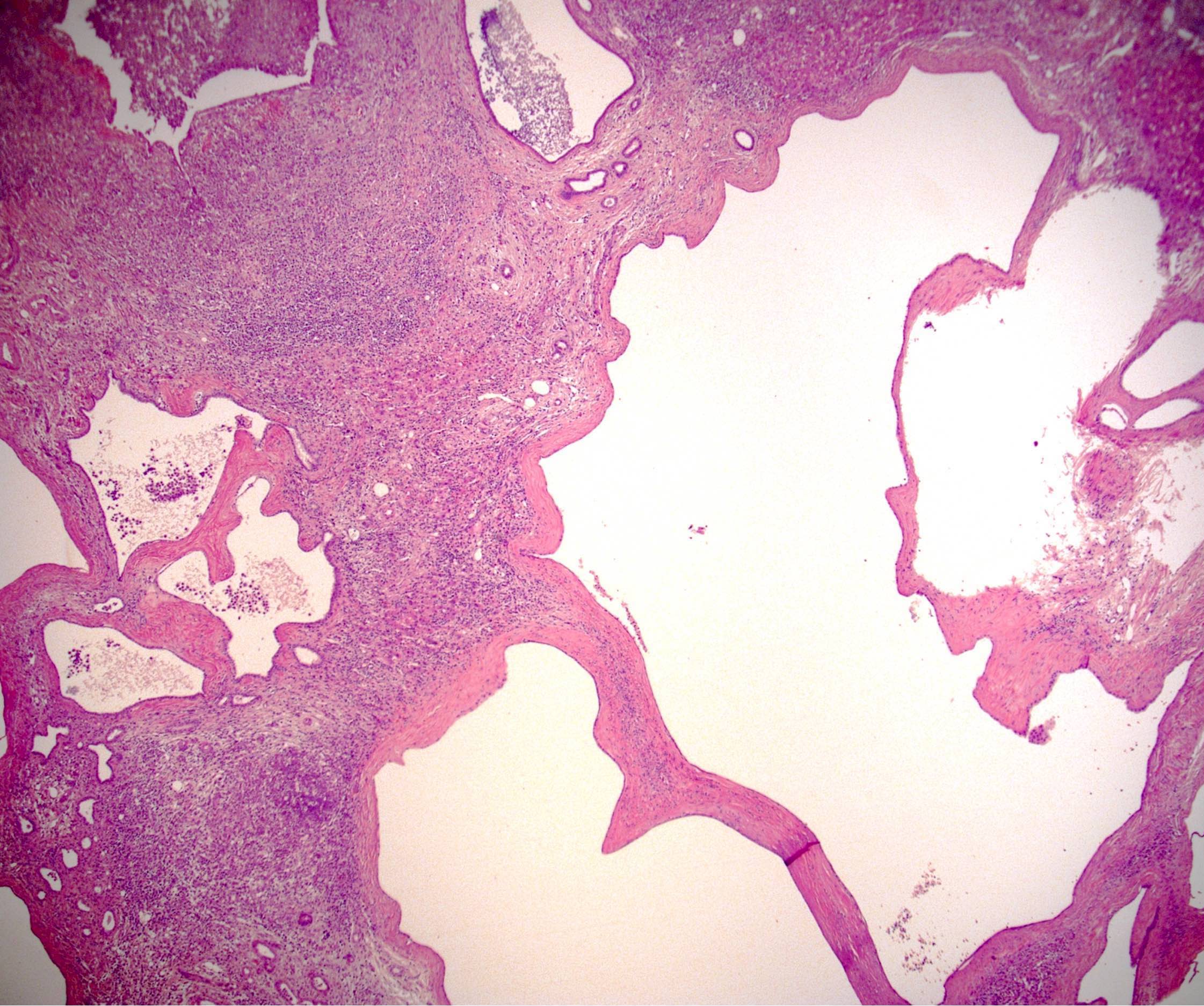
Low power

Cysts

von Meyenberg complex

Liver parenchyma
Additional references


