


Penis & scrotum
Infectious
Balanoposthitis
Authors: Alcides Chaux, M.D., Antonio L. Cubilla, M.D.

Last author update: 1 February 2010
Last staff update: 8 February 2024 (update in progress)
Copyright: 2002-2024, PathologyOutlines.com, Inc.
PubMed Search: Balanoposthitis penis
Table of Contents
Definition / general | Epidemiology | Etiology | Clinical features | Case reports | Treatment | Clinical images | Microscopic (histologic) description | Microscopic (histologic) images | Positive stainsCite this page: Chaux A, Cubilla AL. Balanoposthitis. PathologyOutlines.com website. https://www.pathologyoutlines.com/topic/penscrotumbalanoposthitis.html. Accessed April 24th, 2024.
Definition / general
- Infection of glans and foreskin, usually due to Candida, Staphylococcus, Streptococcus, Garderella, anaerobes or pyogenic bacteria (Acta Derm Venereol 2008;88:331, eMedicine: Balanoposthitis [Accessed 28 March 2018])
Epidemiology
- Common in uncircumcised newborns or uncircumcised men with poor hygiene and accumulation of smegma
- May be due to poor hygiene, sexual transmission or associated with dermatologic disorders
Etiology
- Due to propensity of pathogenic bacteria to adhere to inner mucosal surface of foreskin
- Often sexually transmitted in adults (Hinyokika Kiyo 2005;51:737)
- Also sexually transmitted for adults with Candida albicans, with pathogenicity concentrated to a few genotypes (Clin Infect Dis 2008;47:1119)
Clinical features
- Causes phimosis
- Malassezia is commonly identified but at same rate as in controls (Acta Derm Venereol 2008;88:331)
Case reports
- 5 and 9 year old boys with neutropenia and Pseudomonas aeruginosa infection (Int J Infect Dis 2010;14:e344)
- 58 year old man with granulomatous papules after intravesical Bacillus-Calmette-Guerin (BCG) for bladder cancer (Int J Urol 2006;13:1361)
Treatment
- Antibiotics, based on empiric antifungal therapy (Candida is most common cause) or culture (Int J Dermatol 2009;48:121)
Clinical images
Images hosted on other servers:

Marked ulceration with tissue destruction
Microscopic (histologic) description
- Nonspecific inflammatory infiltrate with lymphocytes, plasma cells and macrophages
- Causative agent usually not discernable by routine examination
- Epithelial changes such as squamous hyperplasia and ulceration can be associated with inflammation
- Fungal hyphae may be present
Microscopic (histologic) images
Images hosted on other servers:
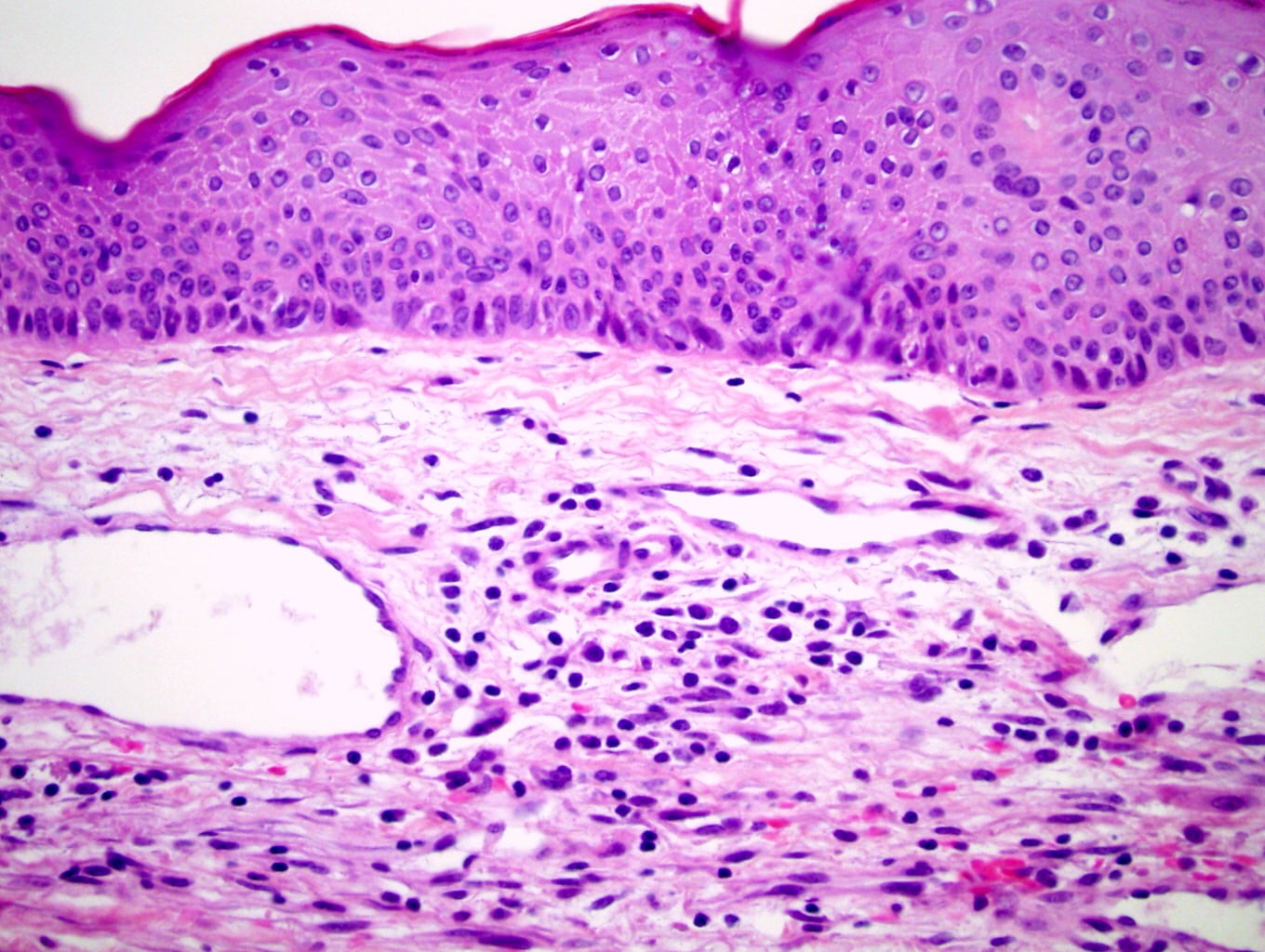
Dermis with
lymphoplasmacytic
infiltrate and dilated
blood vessels


