

Pancreas
Neuroendocrine neoplasms
Somatostatinoma
Author: Raul S. Gonzalez, M.D.
Editor-in-Chief: Debra L. Zynger, M.D.

Last author update: 10 December 2020
Last staff update: 1 September 2022
Copyright: 2002-2024, PathologyOutlines.com, Inc.
PubMed Search: Somatostatinoma pancreas
Table of Contents
Definition / general | Essential features | Terminology | ICD coding | Epidemiology | Sites | Clinical features | Diagnosis | Radiology images | Case reports | Treatment | Gross images | Microscopic (histologic) description | Microscopic (histologic) images | Positive stains | Negative stains | Electron microscopy description | Electron microscopy images | Sample pathology report | Differential diagnosis | Additional references | Board review style question #1 | Board review style answer #1 | Board review style question #2 | Board review style answer #2Cite this page: Gonzalez R. Somatostatinoma. PathologyOutlines.com website. https://www.pathologyoutlines.com/topic/pancreassomatostatin.html. Accessed April 26th, 2024.
Definition / general
- Neuroendocrine neoplasm (may be well differentiated tumor or poorly differentiated carcinoma) that secretes somatostatin, leading to diabetes, cholecystolithiasis, steatorrhea and diarrhea (J Hepatobiliary Pancreat Sci 2015;22:578)
Essential features
- Rare functional neuroendocrine neoplasm that secretes somatostatin
- May appear microscopically as a well differentiated tumor or a poorly differentiated carcinoma
Terminology
- Also called delta cell tumor
ICD coding
Epidemiology
- Rare; fewer than 1% of gastroenteropancreatic neuroendocrine neoplasms (J Gastroenterol Hepatol 2008;23:521)
Sites
- Can occur in the pancreas or in the ampulla / duodenum
Clinical features
- Rare; may be more common in women
- May occur in patients with NF1 (Clin Gastroenterol Hepatol 2009;7:A28)
- Most lesions that stain for somatostatin by immunohistochemistry do not produce somatostatinoma syndrome and arguably do not qualify to be diagnosed as somatostatinomas (Endocr Relat Cancer 2008;15:229)
- Often metastasizes but still usually has good prognosis
Diagnosis
- Imaging to detect pancreatic mass
- Elevated plasma somatostatin levels
Radiology images
Images hosted on other servers:

CT pancreas mass

PET with metastases
Case reports
- 57 year old woman with tumors in pancreas and duodenum (World J Gastroenterol 2009;15:5859)
- 72 year old woman with pancreatic tumor and lymph node metastasis (JOP 2014;15:66)
- 4 patients with tumor in the pancreas and peripancreas (Ann R Coll Surg Engl 2011;93:356)
Treatment
- Surgical resection of primary lesion, if possible
- Hepatic metastases can be resected or embolized
- Octreotide for metastatic disease
Gross images
Images hosted on other servers:

Pancreatic and duodenal tumors
Microscopic (histologic) description
- Some cases are well differentiated neuroendocrine tumor, with nests of monotonous low grade neuroendocrine cells with salt and pepper nuclei and ample amphophilic cytoplasm
- Other cases are poorly differentiated neuroendocrine carcinoma, with nests and sheets of mildly / moderately pleomorphic cells with high mitotic rate, small cell or large cell features (no salt and pepper nuclei) and foci of necrosis
- May rarely feature psammoma bodies (which are common in duodenal somatostatinomas) (J Surg Oncol 1995;59:67)
Microscopic (histologic) images
Contributed by Raul S. Gonzalez, M.D.
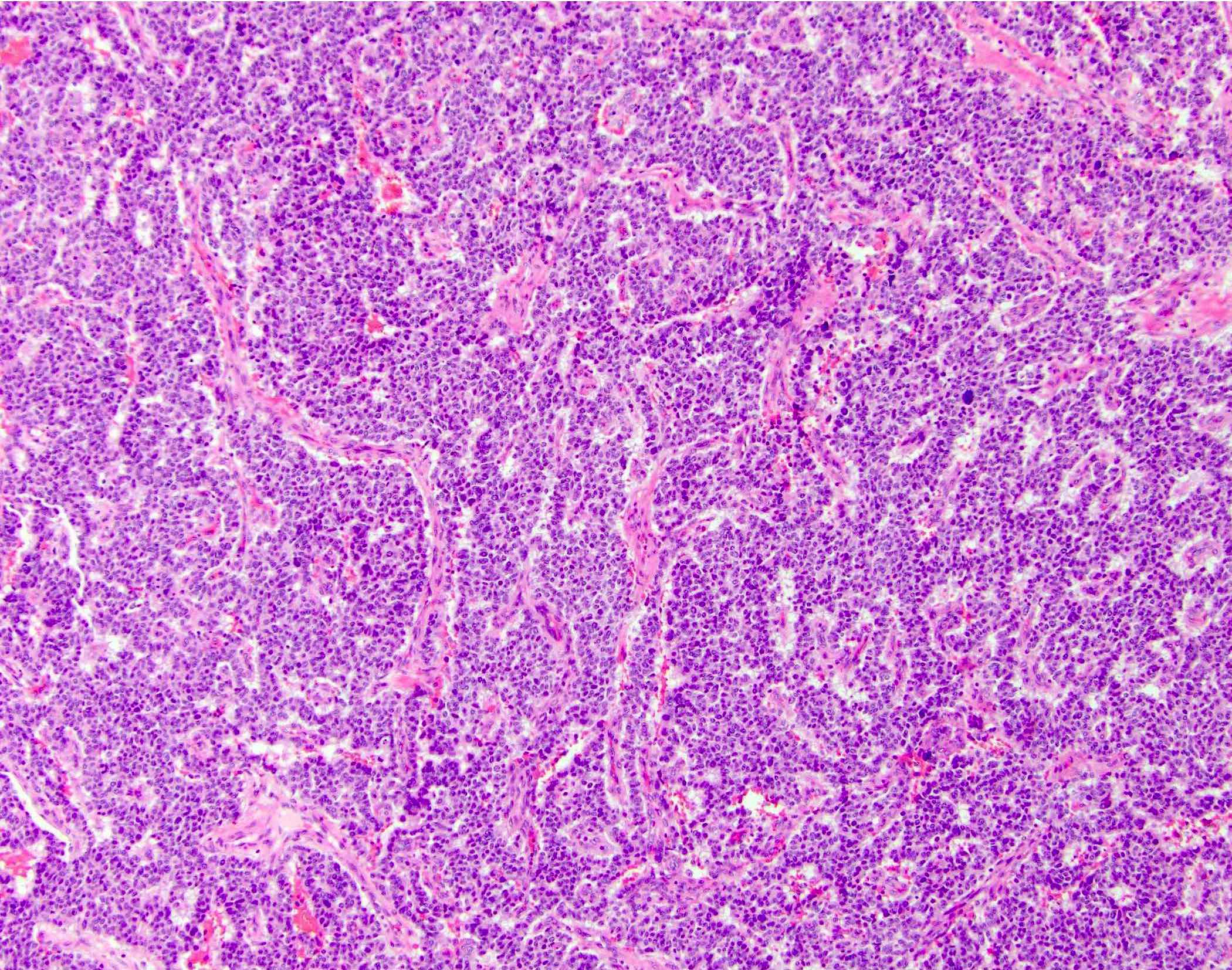
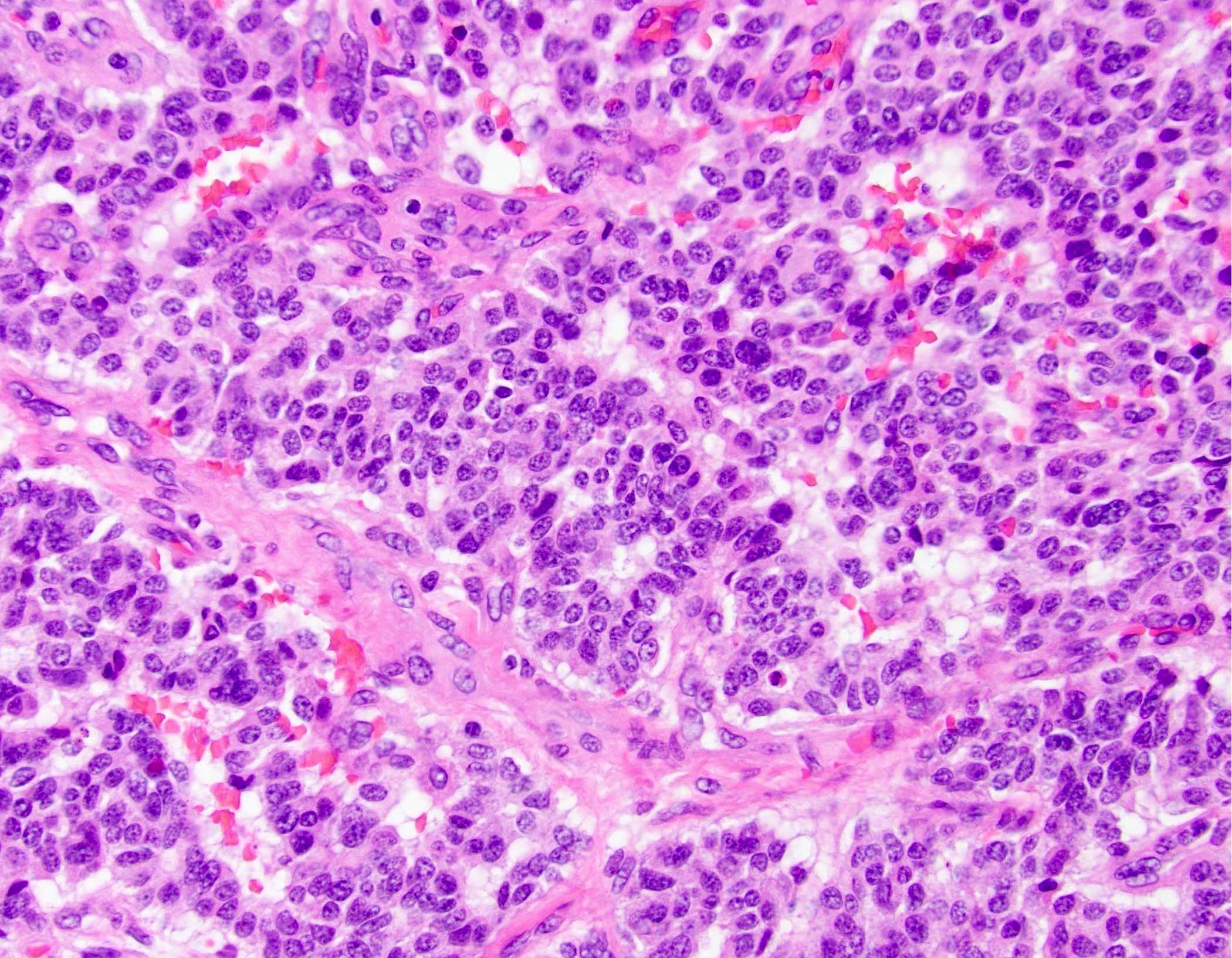
Nests and cords of cells
Positive stains
- Somatostatin (though this does not establish the diagnosis)
- Synaptophysin, chromogranin
- PDX1, INSM1 (Am J Surg Pathol 2012;36:737)
Negative stains
Electron microscopy description
- Tumor cells resemble normal D cells (N Engl J Med 1977;296:963)
Electron microscopy images
AFIP image
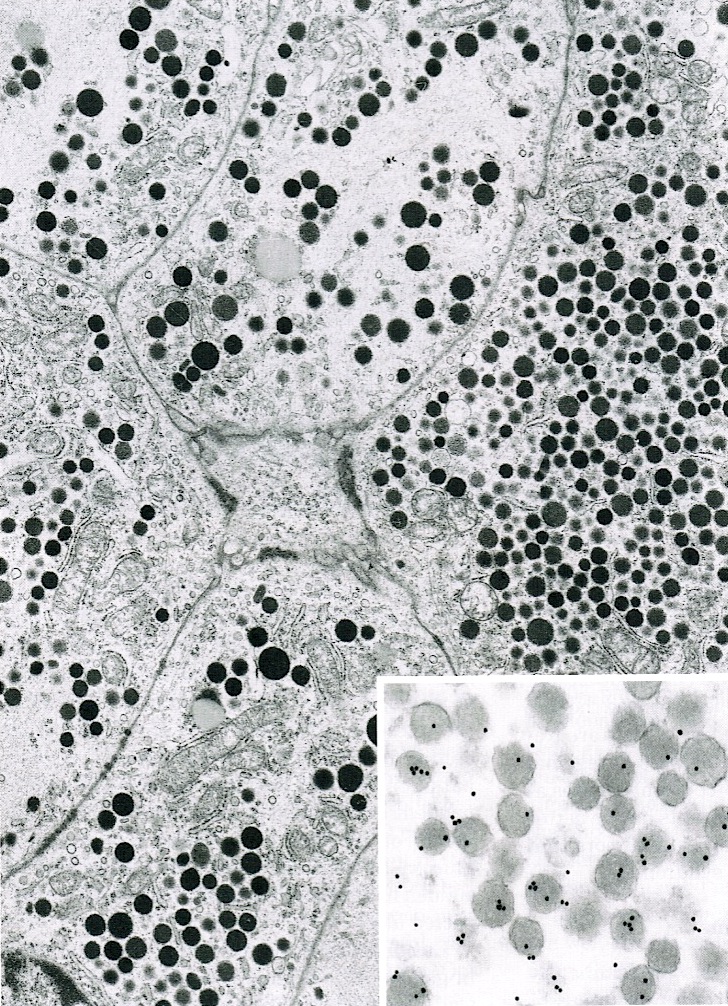
D cell granules
Sample pathology report
- Pancreas and duodenum, Whipple procedure:
- Well differentiated neuroendocrine tumor of pancreas (see comment and synoptic report)
- Comment: Based on the patient’s clinical symptoms, this neuroendocrine tumor is best considered a somatostatinoma.
Differential diagnosis
- Nongastrin secreting pancreatic neuroendocrine tumor or carcinoma:
- No histopathologic differences
- Must be determined on clinical grounds
Additional references
Board review style question #1
- Patients with a somatostatinoma of the pancreas may experience which symptoms?
- Cholelithiasis and steatorrhea
- High volume watery diarrhea
- Hypoglycemia
- Nausea, vomiting and peptic ulcer disease
- Necrolytic migratory erythema
Board review style answer #1
Board review style question #2
- Which of the following is true of pancreatic somatostatinomas?
- They are common in patients with von Hippel-Lindau syndrome
- They are the most common functional pancreatic neuroendocrine neoplasm
- They are typically localized and rarely metastasize
- They may be neuroendocrine tumors or carcinomas
- They usually contain psammoma bodies
Board review style answer #2


